
Almost everyone searching this is deciding one thing: do I hire somebody to answer the phone and book the work, or do I let software do it. A receptionist runs from $36,920 a year before you add a single benefit. Done-for-you AI runs $6,961 in year one with the build included. The number that gets people in trouble is the third option, the one that looks nearly free, where you buy a developer platform at five cents a minute and build the agent yourself. That route usually ends up costing more than both, and this page shows the arithmetic.
What this guide covers

What a Person Actually Costs
Start with the option you already understand. The Bureau of Labor Statistics put the median receptionist wage at $36,920 in May 2023. That is wage only. Payroll taxes, benefits, equipment, software seats and the manager hours spent training all sit on top, and most small businesses land meaningfully above the median once those are counted.
Then there is what the money buys. One person covers roughly 40 hours a week, handles one call at a time, takes holidays, gets sick, and eventually leaves, at which point you pay the ramp again. Calls that arrive at 7pm on a Saturday go to voicemail either way.
| Route | Typical cost | Coverage | The catch |
|---|---|---|---|
| In-house setter or receptionist | From $36,920 a year in wage, plus payroll overhead and commission | About 40 hrs a week | Weeks of training, one call at a time, nothing after hours, and you train the next one when they leave. |
| Answering service | Published plans commonly start a few hundred dollars a month for a small block of minutes or calls | 24/7 on higher tiers | Most take a message. The lead still waits for someone to ring back, so the speed advantage is only half captured. |
| Outsourced setting agency | $1,000 to $5,000 a month on retainer, or $50 to $200 per booked appointment | Varies by contract | Shared reps and variable quality. You often pay for appointments that never show. |
| Done-for-you AI | $497 a month plus a one-time build, on our published Starter plan | 168 hrs a week | Complex, high-ticket, rapport-heavy conversations get warm-transferred to a person rather than won by the agent. |
Agency and answering-service figures are market ranges, not quotes from a named vendor. The wage figure is the BLS median, linked above.
The structural difference is what happens as you grow. A person prices per hour and an agency prices per appointment, so the bill climbs with volume. Software prices flat or per minute, so cost per appointment falls as volume rises. That argument only holds if the thing actually books, which is why speed to lead and booking rate matter more than the monthly fee.

What Done-For-You AI Costs
Done for you means nobody on your side builds anything. We write the conversation, wire the calendar and the CRM, provision the numbers, test it, and launch it. When it says something wrong, we fix it, and script optimisation is part of the plan rather than a favour.
| Plan | Monthly | One-time build | What it covers |
|---|---|---|---|
| Starter | $497 | $997 | 1 agent, 1,000 minutes, about 330 calls a month. One script optimisation a month. |
| Growth | $997 | $1,497 | 2 agents inbound and outbound, 2,200 minutes, about 730 calls. Three script optimisations a month. |
| Enterprise | $1,997 | $1,997 | 3 agents, 5,000 minutes, about 1,665 calls. Four optimisations a month and quarterly strategy reviews. |
Current plans as published on our pricing page. Month to month, with a 14 day refund and a 30 day booking guarantee.
Against a hire, the comparison is not close on money. Starter is $6,961 across year one including the build. The median receptionist wage alone is more than five times that, and the agent answers every hour of every day rather than forty hours a week.

Why Building It Yourself Costs More
Developer platforms publish rates around five cents to fourteen cents a minute. Next to $497 a month that looks unanswerable, and if the invoice were the cost it would be. The invoice is not the cost.
A production voice agent is not a prompt. It is the conversation and every branch of it, the handling for when a caller says something nobody planned for, two-way calendar availability, the CRM connection, provisioned numbers, and testing against real recordings until you trust it with a customer. Then it goes live and the actual work starts, because every call it fumbles is a script you go back and fix.
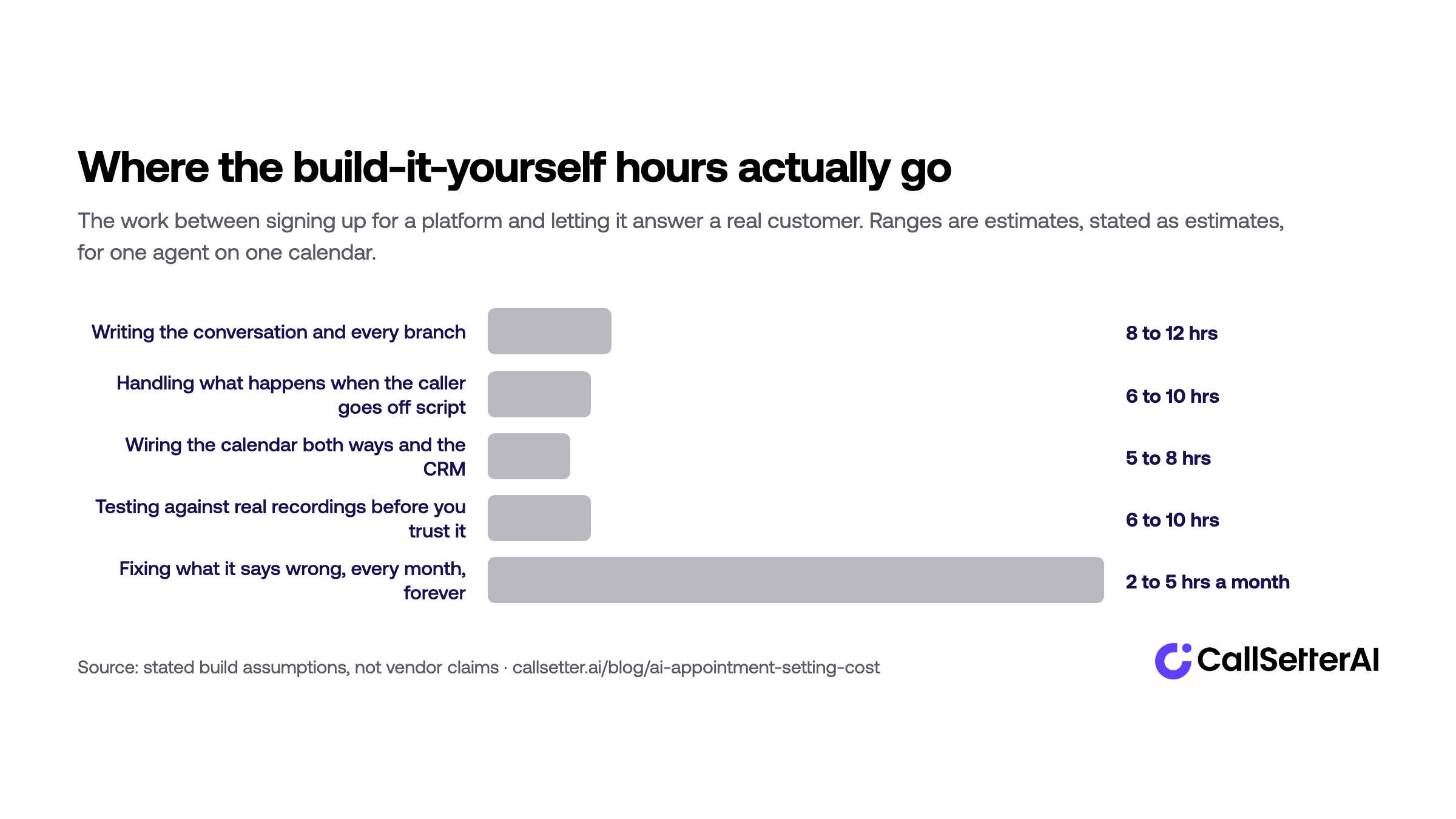
Cost your own hour at $100 and the picture changes fast. A build that goes well is about 20 hours up front and 2 hours a month after, which is 44 hours across year one, or $4,400 of your time on top of the platform bill. A build that goes the way most of them go is 40 hours up front and 5 a month, which is 100 hours, or $10,000. That is the real spread, and the low end assumes nothing surprises you.
Two things make the high end more likely than the low. The first is that you do not know what your callers will say until they say it, so the off-script handling is written after launch, from recordings, in small painful increments. The second is that you are the escalation path. When the agent misroutes an emergency call at 9pm, you are the person who finds out, and you find out from the customer.
The three costs that never reach the invoice
- Your hours. 44 to 100 of them in year one, at whatever your hour is worth. This is the big one and no pricing page anywhere prints it.
- The calls it drops while you are still tuning it. Every week the agent is half-built is a week of leads handled by voicemail. What a missed call is worth puts a number on that side.
- Passed-through model costs. On a developer platform, speech-to-text, the language model and text-to-speech are billed on top of the per-minute rate. Not hidden, just left out of the headline everyone quotes.

Year One, Side by Side
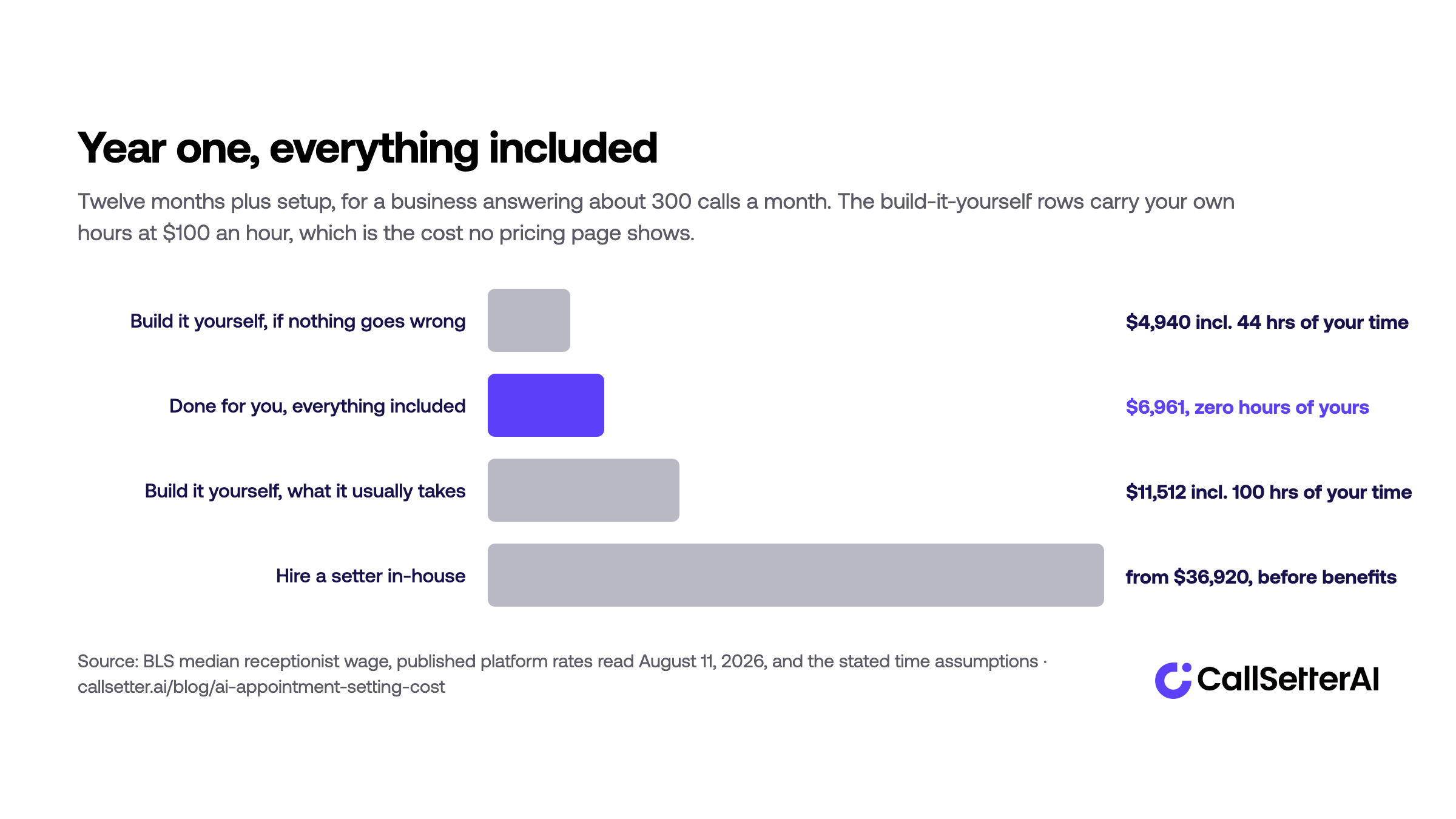
One business, about 300 calls a month, twelve months plus setup. Your hours costed at $100 because they are worth something even when nobody invoices you for them.
Embed this chart (free, attribution required)
Read the two build-it-yourself bars together, because that is the honest way to read them. If everything goes right you save about $2,000 against done for you, and you pay for it with 44 hours. If it goes the way it usually goes you spend $11,512, which is 65% more than done for you, and you still spent the 100 hours. You are not choosing between cheap and expensive. You are betting your own weeks on the good outcome, and the losing side of that bet costs more than just buying it finished.
Against hiring, neither software route is close. A person starts at $36,920 in wage alone and covers a quarter of the week.
Your Cost per Booked Appointment
Monthly price is a vanity number. The figure that should drive the decision is what each booked appointment costs you, because that is the thing you are actually buying. Put your own numbers in.
Cost per booked appointment calculator
Runs entirely in your browser. No form, no email gate, no hidden multipliers.
The formula, in the open: calls answered x booking rate = appointments. Monthly cost divided by appointments = cost per appointment. For year one we take appointments x close rate x revenue per job x 12, then subtract twelve months of fee and the one-time setup. Every input is yours. There is no assumed lift, no industry multiplier, and no CallSetter figure other than the numbers you type in.
What Moves the Invoice
The advertised price is rarely the number you pay. Five things move it, whichever route you pick.
- Overage. Every subscription has a cliff, and the per-minute rate past it is always higher than the rate inside it. Estimate your real monthly minutes and price the tier above the one you think you need. Ours starts at 1,000 minutes on Starter and the current overage rates are on the pricing page.
- Passed-through model costs. Build-it-yourself platforms bill speech-to-text, the language model and text-to-speech on top of the headline per-minute rate. Ask for a worked example at your volume, not a rate card.
- Integrations behind a tier. The calendar or field service software you actually run may sit on a higher plan. Check ServiceTitan, Housecall Pro, Jobber and your CRM by name before you compare anything.
- Setup fees. Done-for-you providers charge for the build. Ours runs $997 to $1,997 depending on tier. A low monthly with a large setup is not cheaper, it is amortised differently.
- Contract terms. Annual commitments with early termination fees are common, and an annual discount is a real saving with a real lock-in attached. Month to month costs more and is worth it while you are still finding out whether the thing works.
Where We Are the Wrong Choice
We are a done-for-you service, and that is a specific trade. You give up the keys and you get the hours back. Four situations where that trade is bad for you.
- You have engineers and spare time. If building it is genuinely free for you because someone salaried does it between other work, the platform bill really is the whole bill, and it beats us. Be honest about whether those hours exist.
- You take a handful of calls a day. At low volume a cheap packaged tool will do the job and our build fee never pays for itself.
- Your callers need a person. If the call is the product and a confused caller has to reach somebody who can improvise, hire the person. Our agent transfers to a human, it does not replace one for that kind of conversation.
- You want to change the script at 11pm without asking anyone. Done for you means we make the changes. A self-serve builder hands you the keys, and for some people that control is worth the hours.
Where we do win: nobody on your side builds anything, the price includes the scripting and the integrations, the fixes are part of the plan rather than your evening, and it is month to month with a 14 day refund and a 30 day booking guarantee. Full terms are on the pricing page.
How to Read a Quote
Ten questions that make two quotes comparable. Ask all of them in writing. The vendor who answers plainly is usually the one to buy from.
- How many minutes or calls are included, and what is the overage rate?
- Are the model and telephony costs included, or billed on top?
- Is 24/7 coverage in the base price or an upgrade?
- Does the agent book into the calendar, or take a message for a callback?
- Which calendar and CRM integrations are included at this tier, by name?
- Is there a setup fee, and what does it cover?
- Month to month, or an annual commitment with a termination fee?
- Are call recordings and transcripts included, and for how long?
- Who edits the script when it says something wrong, and how fast?
- What happens on the calls the AI cannot handle?
Where to Go Next, Based on Your Situation
- You want a number for your own call volume: book a demo and we will price it against your real minutes, overage included.
- You want to see our plans without talking to anyone: CallSetter AI pricing.
- You are weighing this against a hire: AI receptionist versus a human receptionist runs the same comparison on coverage and consistency.
- You are still deciding whether this is worth it at all: the cost of missed calls puts a number on the other side of the ledger.
- You want your industry's setup: HVAC, plumbing, roofing, solar, dental, or law firms.
Frequently Asked Questions
How much does AI appointment setting cost in 2026?
Done for you, where somebody builds and runs the agent, starts around $497 a month plus a one-time build, which is $6,961 across year one on our Starter plan. Building it yourself on a developer platform starts near zero on the invoice and typically lands around $11,512 in year one once your own hours are counted. Hiring a person instead starts at $36,920 a year in wage alone.
Is AI appointment setting cheaper than hiring someone?
Yes, and not by a small margin. The median receptionist wage is $36,920 a year before benefits, payroll taxes or equipment, and that buys about 40 hours of coverage a week. Done-for-you AI at $6,961 for year one answers every hour of every day. The comparison only holds if the agent actually books appointments rather than taking messages, so ask any vendor to show you booking rate, not just price.
Is it cheaper to build my own AI voice agent?
On the invoice, yes. In total, usually not. Platform rates of five to fourteen cents a minute exclude your build time, and a production agent takes roughly 20 to 40 hours before the first real call plus 2 to 5 hours a month after that. At $100 an hour that is $4,400 to $10,000 of your year, which puts the typical build-it-yourself total above done for you. It is the right choice when those hours genuinely cost you nothing.
What is a fair cost per booked appointment?
Divide the monthly cost by the appointments actually booked. A receptionist at roughly $3,700 a month booking 60 to 80 appointments works out at $46 to $61 each. Done-for-you AI at $497 a month booking 40 appointments is about $12 each. The metric only means something once you know the booking rate, which is why the monthly sticker price is a poor way to choose.
What hidden costs should I check before signing?
Overage rates past your included minutes, whether model and telephony costs are billed on top, whether your specific calendar and CRM integrations sit behind a higher tier, the one-time setup fee, and the contract term. On a build-it-yourself platform, add your own hours, which is the largest line and the one nobody quotes.
How much does CallSetter AI cost?
Starter is $497 a month with a $997 one-time build, covering one agent and 1,000 minutes, about 330 calls. Growth is $997 with a $1,497 build for two agents and 2,200 minutes. Enterprise is $1,997 with a $1,997 build for three agents and 5,000 minutes. Month to month, 14 day refund, and you do not pay if your booked appointments do not increase in the first 30 days live. Current terms are on the pricing page.
Methodology and Sources
The wage figure is the median annual receptionist wage published by the US Bureau of Labor Statistics for May 2023, and it is wage only, before benefits or payroll taxes. Agency retainers and answering-service prices are stated as market ranges rather than quotes, and are labelled as ranges wherever they appear.
Our own prices were read from the CallSetter AI pricing page on August 11, 2026. Year one for Starter is twelve months at $497 plus the $997 build, which is $6,961.
Build-it-yourself totals combine published developer-platform rates of $0.05 to $0.14 a minute at about 900 minutes a month with the time assumptions stated on this page: 20 to 40 hours to build and 2 to 5 hours a month to maintain, costed at $100 an hour. Those hour figures are estimates and are presented as estimates. They are not measured from a sample, and your build may be faster or slower. The per-minute rates exclude the speech-to-text, language model and text-to-speech costs those platforms pass through, which makes the build-it-yourself totals conservative rather than inflated.
Nothing on this page is a projection of results. The calculator uses only the numbers you type into it, with no assumed lift and no industry multiplier.
How to Cite This Page
You are welcome to reference the figures and charts on this page. Copy the citation below and link back to the canonical URL.